Pages

Showing posts with label Indian cuisine. Show all posts

Monday, July 19, 2021

Indian Sliced Onion Pickle


My new addiction. These onion pickles have an almost perfumed quality that I wasn't sure I liked at first, but they have become a daily habit--on sandwiches, on poké bowls, on salads, as a side with curries. They come from a recently released Dutch cookbook written by an Indian expat. 

The book (De Bible van de Indiase Keuken by Paulami Joshi) covers many familiar recipes, certainly for someone like me who has got a fair collection of Indian cookbooks. The recipes are grouped by region and they include some unfamiliar dishes. The book has good illustrated how-to sections on making breads and some other things. It's one weakness is the index, which is almost useless unless you know the exact recipe name. Look under a recipe's major ingredient, like cauliflower or, in this case, onions, and you won't find the recipe listing.

But the recipes are great and this one is a real gem. 

Ingredients

240 ml (1 cup) vinegar
120 ml (1/2 cup) water
3 cloves
1 black cardamom pod, bruised
3 green cardamom pods, bruised
1 cinnamon stick
200-250 g (7-8 oz) red onions or shallots, thinly sliced
1 teaspoon sugar
2 teaspoons salt

Directions

Have ready a sterilized 400 ml jar with a screw-on lid.

  1. In a small saucepan, bring the vinegar, water, and spices to a boil, then simmer for 5 minutes.
  2. While that simmers, thinly slice the onions and put them in the sterilized jar.
  3. Pour the spiced liquid and spices over the onions, screw on the lid and let cool. once it has cooled, keep it in the fridge for up to 2 months. (My first batch only lasted for 3 weeks.)

Source: De Bible van de Indiase Keuken By Paulami Joshi


Monday, September 23, 2019

Hyderabadi Tomato Curry with Eggs


I'm always on the lookout for good vegetarian and Indian cookbooks that may offer something new. On a recent trip to Canada, I struck gold with Vegetarian India: A Journey Through the Best of Indian Home Cooking by the goddess of Indian cooking in the West, Madhur Jaffrey. It was published in a slightly different form in Great Britain as Curry Easy Vegetarian. Although  I prefer the metric measures and weights provided in British and European cookbooks, this edition has a more extensive introduction about how and where she collected these recipes. I won't be replacing it!

I have been cooking from it since I got back, and I haven't hit a dud yet, although I always end up making adjustments, sometimes inadvertently.

Sauce without water
For example, Jaffrey never includes water in her list of ingredients, so you have to be very attentive when reading her instructions,because it may be included there. The first time I made this tomato curry, I missed seeing the added 2 1/2 cups of water, so the curry turned out to be quite thick (but delicious!).

I thought at the time that I would add some water the next time I made it. When I did, I noticed my error but decided not to add as much water as she recommends. And I made some other tweaks in the spices (more chili and turmeric) and tamarind paste.

Hyderabadi Tomato Curry with Eggs

Serves 4

This simple tomato curry could be served for any meal along with some rice. The sauce is delicious, gently spiced with a sour note from the tamarind. It may be even be better the next day, so I make up a full batch (instead of my usual half recipes) and stock the freezer for a quick meal. It goes well with eggs, but I think it would also be great with fried paneer or little meatballs.

Ingredients
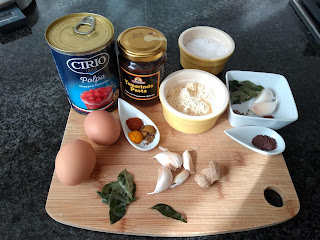
3 tablespoons chickpea flour
6 tablespoons water
1 1/2 cups pureed tomatoes, passata, or crushed tomatoes (equivalent to 1 can of 400 grams)

1 1/2 to 2 1/2 cups water, depending on your tomatoes and preferences
1 teaspoon tamarind paste
1 1/2 teaspoons salt

2 tablespoons oil
6-7 curry leaves *
2 teaspoons ginger, grated
4 cloves garlic, crushed

1/2 teaspoon cumin, ground
1/2 teaspoon kashmiri (red) chili powder, or hot paprika
1/2 teaspoon ground turmeric

4-6 hard boiled eggs

Tarka:
2 tablespoons oil
1/4 teaspoon brown mustard seeds
3-6 hot dry chilis
2 cloves garlic, sliced into long slivers
6-7 curry leaves *

Cilantro for garnish

* Fresh curry leaves may be hard to find. You can use frozen or dried curry leaves, and otherwise just omit. 

Directions

  1. Hard boil the eggs. I prick a hole in the bottom of the eggs, then submerge them in boiling water and simmer for 9 minutes for medium to large eggs. 
  2. Heat a small frying pan over medium-high heat, then add the chickpea flour and toast it for a few minutes, stirring, until it turns a shade darker. Transfer to a medium bowl to cool. When it is cool, mix in 6 tablespoons of water until there are no lumps.
  3. Add the tomatoes, tamarind paste, salt, and 1 1/2 cups of water. Mix well and set aside.
  4. Heat the oil in a saute pan (preferably non-stick) over medium high heat. 
  5. When the oil is hot, add the curry leaves, followed by the ginger and garlic, and stir a few times.
  6. Turn the heat down to low, then add the cumin, chili powder, and turmeric, and stir a few times.
  7. Add the tomato puree mixture, and bring to a boil over medium high heat, stirring constantly.
  8. Turn down the heat and simmer for 10 minutes, stirring now and then. If you find the sauce too thick, add some more water. If you want it thicker, cook it for a bit longer.
  9. For the final seasoning (the tarka), heat the oil in a small frying pan.
  10. When it is very hot, add the mustard seeds, and when they begin to pop, add the chilis and cumin seeds.
  11. When the chilis darken, add the slivered garlic and brown slightly.
  12. Adding the curry leaves, and quickly pour the lot over the tomato sauce. Stir well.


To serve, pour the tomato sauce in a shallow serving dish. Slice the eggs in half  lay them on top of the sauce.  Dribble a bit of sauce over the eggs and garnish with shopped cilantro. Serve with rice.


Monday, January 1, 2018

Marinated Sweet and Sour Fish

I love fish but don't eat it often enough, which is odd considering how quick it can be to cooked for a weeknight supper. This recipe does not fit into the weeknight supper category unless you make it the day before, but it is lovely if you do! It features fried fish fillets and sweet peppers in a curry-flavoured sweet and sour marinade.

I usually make it with pollack or cod fillets, but you you could use any firm-fleshed sustainably-sourced fish, including halibut, hake, or haddock fillets, or small fish, such as red mullet, sardines, or small mackerel.

It is meant to be served at room temperature as a starter or light supper, but I have also served it warmed up as part of an Indian meal. In fact, in winter I always prefer it warm.

The recipe is adapted from Ottlogenghi's Jerusalem cookbook, but it reminds me a bit of a South African recipe for pickled fish that I encountered in the Time-Life Foods of the World: Africa cookbook. Ottolenghi gives Danielle Postma the credit for this recipe, and Postma is a Dutch (Frisian) name which I assume would also be common in South Africa, so who knows where its origins really lie.

Marinated sweet and sour fish

I adapted the original recipe by finishing the dish on the stove top, rather than transferring it to the oven to cook for 10-12 minutes. Fish is delicate and overcooking it is a cardinal sin, so if it is almost cooked during the frying stage, it is easier to keep an eye on it on the stove.

You can start the marinade first and fry the fish in a separate frying pan as the marinade cooks, or start by frying the fish and then use the same pan to make the marinade. If you are using a single pan, use a saute pan or casserole that is large enough to accommodate the vegetables and fish. Either way, the fish is added to the marinade at the end.


Fish:

500-600 grams sustainably-sourced fish fillets or small fish, scaled and gutted
2-4 tablespoons of flour, seasoned with salt and pepper
1 large egg, beaten
1 tablespoon oil

Marinade:

2 medium onions, sliced 1 cm thick.
2 bell peppers, 1 red and 1 yellow, sliced in 1 cm strips
3 medium tomatoes, chopped
2 garlic gloves, crushed
2 tablespoons oil
1 tablespoon coriander seeds
3 bay leaves
1 1/2 teaspoons curry powder
2 1/2 tablespoons sugar
5 tablespoons apple or cider vinegar
1 to 1 1/2 teaspoon salt
pepper
aprox. 250 ml water
1-2 tablespoons coriander leaf for garnish


  1. Prepare the vegetables, slicing the onions and peppers 1 cm thick, and chopping the tomatoes.
  2. Sprinkle the fish with salt, roll in the seasoned flour, then dip in the egg. (This helps to keep the fish together in the marinade, so don't omit this step.)
  3. Heat 1 tablespoon of oil in a large frying pan or saute pan. 
  4. Fry the fish for 3 minutes on each side, then transfer to paper towels and set aside. 
  5. Wipe out the pan, and heat 2 tablespoons of oil.
  6. Add the onions and coriander seeds, and saute on medium heat for 5 minutes, stirring often.
  7. Add the peppers and cook for another 10 minutes.
  8. Add the garlic, bay leaves, curry powder and tomoatoes, and cook for 8 minutes, stirring occasionally.
  9. Add the sugar, vinegar, 1 1/2 teaspoons, several grinds of pepper and continue to cook for 5 minutes.
  10. Add the fish to the pan, pushing the vegetables aside so the fish is nestled on the bottom of the pan.
  11. Add about 250 ml water to the pan, just enough to ensure the fish is submerged, then bring up to a gentle simmer.
  12. Poach the fish for 1-3 minutes until it is just cooked, and flakes when you gently insert a knife. The time required depends on the type of fish and the thickness of the fillets. (Personally, I think it is better if it is slightly underdone and finishes cooking in the marinade as it cools.)
  13. Remove the pan from the heat and let it come to room temperature. 
  14. You can serve it now or let it sit in the fridge for a couple of days. 
  15. To serve, let it come to room temperature or heat it up gently on stove. Taste, adjust the seasoning and sprinkle with chopped coriander leaf for garnish.


Thursday, December 8, 2016

Addictive Beetroot Kebabs

A couple of months ago, I acquired a new cookbook by Meera Sodha called Fresh India. This is a fabulous book and I have it almost constantly open on my cookbook stand. The recipe I turn to most frequently is one that uses that under appreciated vegetable--beetroot. This recipe is so good, even people who don't like beets (like my brother-in-law) love them.

Although I live alone, I make a whole batch of these and keep some of the patties in the fridge or freezer and fry them up when desired. They can be served as an appetizer or snack, or you can make them the focal point of an Indian meal, with some rice, dal, and raita on the side.

For me, this is almost fast food because I can buy cooked beets in the local supermarkets and greengrocers, and paneer cheese in a little Indian/Suriname store near me. But cooking beets is not hard, and you can make your own paneer too (see Saag Paneer). But I have also made it with drained cottage cheese. I think you could make it with soft feta cheese too (although I would reduce the salt then).

These kebabs are quite soft and delicate. They need to be gently handled, but are easy to make.

2018-01-01 Update: I no longer add an egg to the mixture. It just makes it too wet and the chickpea flour is enough to bind it. I have also used this mixture in samosas made with filo pastry.

Indian Beet Kebabs

Adapted from Meera Sodha
Yield: 18 small patties

500 g cooked beets 
225 g paneer cheese (or cottage cheese or feta)
2 tablespoons lemon juice
4 cm fresh ginger, peeled and minced fine or grated
3 cloves garlic, minced or puréed 
2 small green chillies, chopped fine
1 teaspoon garam masala
1.5 teaspoons salt
4 tablespoons chickpea flour (or wheat flour)
30 grams fresh coriander, chopped fine
1 egg, beaten (optional)
1 tablespoon oil, for frying


  1. Purée the cooked beets in a blender or food processor. (I use my immersion blender.)
  2. Pour the beet purée into a large frying pan and cook for 5 to 10 minutes to reduce the liquid.
  3. Crumble in the paneer or other cheese, and mix thoroughly.
  4. Add the lemon juice, ginger, garlic, chillies, garam masala, and salt. Cook for another 5 minutes.
  5. Take the mixture off the heat and stir in the chickpea flour and chopped coriander. Let it cool down.
  6. Add the egg and mix thoroughly.
  7. Take 1-2 tablespoons of the mixture and roll it into a ball, then gently flatten it and place it on a plate or baking tray lined with parchment paper. You should get 18 to 20 patties. At this point you can choose to chill or freeze the for future use.
  8. Heat a teaspoon of in a small frying pan over high heat, then add 4 patties and fry for 1.5 to 2 minutes. Gently turn the patties over and fry for another 1.5 minutes.
  9. Transfer the kebabs to a plate and serve with cucumber yoghurt raita and naan bread or pappadums.

Sunday, October 20, 2013

Vegetable Curries


I went on a curry bender last week, cooking four different vegetable curries in four days. Accompanied by some raita and mango chutney, the last evening was a feast. The freezer is now well stocked too!

As the following list shows, I'm very fond of aubergine (or eggplant; I'm indiscriminate in the term I use). The first two recipes, I've made and blogged about before, but two were new, adapted from the Madhur Jaffrey Cookbook.


  • Aubergine bharta —roasted and peeled eggplants cooked down into a pillowy, spiced mass
  • Saag paneer —spinach curry, but made with haloumi cheese instead of paneer. The firm, salty haloumi worked really well here. Firm feta or tofu would also be an option.
  • Aubergine curry—such a fast simple curry with great flavour coming from the combination of fennel seed and fenugreek seed.
  • Cauliflower curry—another easy curry that does great things for somewhat bland cauliflower
Cubed Aubergine with Onions
Adapted from The Madhur Jaffrey Cookbook

1200 g aubergine (about 3-4 medium)
1 teaspoons salt
2-3 tablespoons oil
1 teaspoon fennel seeds
1/2 teaspoon fenugreek seeds
2 medium onions, coarsely chopped
1 teaspoon coriander seed
1 teaspoon ground cumin
1/4 teaspoon cayenne 
1 teaspoon lemon juice
225 ml water

  1. Cut the aubergines into 2 cm cubes and put into  bowl with the salt. I like the skin, so I leave it on, but the original recipe calls for peeling it first.
  2. Optionally, let the aubergines sit for an hour, then squeeze out as much of the liquid as you can. (I often skip this step when I'm in a hurry.)
  3. Heat the oil in a large heavy skillet over a medium heat, then add the fennel and fenugreek seeds. As soon as they darken (after a few seconds), add the onions and aubergine cubes.
  4. Stir and fry for about 20 minutes, adjusting the heat to prevent burning. The aubergines will at first absorb the oil but will release it again after a few minutes.
  5. Add the coriander, cumin, cayenne and lemon juice and fry for a few minutes, then add the water, cover, and cook for another 15 minutes until the aubergine is thoroughly soft and cooked.
  6. Adjust to taste with salt and/or lemon juice.

Cauliflower with Onion and Tomato

1 medium onion, coarsely chopped
4 cloves garlic, peeled and chopped
2-3 cm pieces of ginger, peeled and chopped
4 tablespoons water
1 head cauliflower, broken into florets and stem coarsely chopped
3 tablespoons oil
1/2 teaspoon turmeric
1 medium tomato, (peeled and) chopped
1 tablespoon cilantro, chopped
1 fresh green chili, finely sliced
2 teaspoons ground coriander
2 teaspoons ground cumin
1 teaspoon garam masala
1 teaspoon salt
1 tablespoon lemon juice

  1. Put the onion, garlic, ginger, and water in a blender and pulse into a paste.
  2. Heat the oil in a large pot over a medium flame. Add the onion-garlic-ginger paste and the turmeric. Stir and fry for 5 minutes.
  3. Add the chopped tomato, cilantro, and chili and fry for 5 minutes.
  4. Add the cauliflower florets and the coriander, cumin, garam masala, water, and lemon juice. Stir, cover, lower the heat and let cook for about 35 minutes until the cauliflower is tender but not mushy.


Monday, September 19, 2011

Tracking Recipes

I don't write up all the recipes I try, but that's not to say I don't have opinions about them or want to keep them accessible. If a recipe comes from a cookbook that I own or from a cooking blog I frequent, I will sometimes review it on Cookbooker, rather than blog about.

Not only is it a way to keep my own comments about a recipe, it gives me insight into what other people may have done with it, which can be quite helpful.

For a list of my recipe reviews, check out Barbara's Reviews.

Here's a list of some of the recipes I've tried and might make again with modifications:

Red Wine Chocolate Cake
Minestrone all Romagna
Cubed aubergine cooked with onions
Cauliflower with a cashew and sesame seed sauce
Curried cauliflower
Easiest Baked Macaroni and Cheese

Sunday, February 13, 2011

Cooking Sundays

Sundays tend to be the day I cook for the rest of the week. Saturdays are spent in errands, or lazing around recovering from the work week, or browsing through recipes planning things I'd like to try. But Sundays I get up, bright-eyed and bushy-tailed, ready to cook. Today the agenda called for polpettini, eggplant curry, a lamb stew or curry, and deviled eggs (for the apartment potluck reception  this afternoon).


Polpettini

This is a recipe slightly adapted from a contribution my sister and brother-in-law made to our family cookbook. The amount made here will make about 18 meatballs (3-4 servings), but you can easily double the recipe.
  • 1 tablespoon porcini mushrooms
  • 1/3 cup warm water
  • 260 grams ground beef
  • 1 cloves garlic, minced
  • 2 tablespoons fresh parsley chopped
  • 1/4 teaspoon dried basil
  • 1/2 beaten egg
  • 3 tablespoons bread crumbs
  • 1 tablespoons Parmesan cheese freshly grated
  • salt and pepper
  • 2 tablespoons olive oil
  • 1 onion very finely chopped (divided)
  • 1/3 cup dry white wine
  • 1 tomato, chopped
  • fresh parsley, to garnish
  1. Soak the dried mushrooms in the warm water for 15 minutes. Lift them out of the water and chop finely. Reserve the soaking water.
  2. In a mixing bowl, combine the meat with the chopped mushrooms, half the chopped onion, garlic, and herbs. Stir in the egg. Add the breadcrumbs and Parmesan, and season with salt and pepper. Form the mixture into small balls containing about 1 tablespoon each.
  3. In a large heavy frying pan or skillet, heat the oil. Add the onion and cook over low heat until soft. Raise the heat and add the meatballs, rolling them often to brown evenly on all sides. After about 5 minutes add the reserved mushroom water. Cook for another 5-8 minutes, or until the meatballs are cooked through.
  4. Remove the meatballs to a heated plate with a slotted spoon. Add the wine to the pan and cook for a minute or two,  stirring to scrape up any residue on the bottom of the pan. then add the chopped tomato and reduce the sauce by about half.
  5. Pour the sauce over the meatballs , garnish with parsley, and serve with pasta or potatoes.


Bharta (Curried Eggplant)

One of my staple vegetables is eggplant. I love it in almost every imaginable guise—in baba ganough, in lamb stew, roasted, grilled, you name it, I love it. Yesterday I bought a package of three smallish ones, so I was on the hunt for some new recipes to use it up. The recipe I ended up using comes from an old cookbook that I was considering getting rid of. But this looks like it might be a bit premature, given how good this curried eggplant was!

Adapted from The Cooking of India

  • 500 grams eggplant
  • 2 tomatoes, chopped
  • 2 tablespoons fresh coriander, chopped
  • 1 teaspoon coriander seed
  • 1 teaspoon cumin seed
  • 1/2 teaspoon turmeric
  • 1/4 teaspoon chili flakes or small dried chili
  • 1 tablespoon oil
  • 1 teaspoon butter
  • 1 clove garlic, minced
  • 1 teaspoon fresh ginger, minced
  • 1 onion, chopped
  • salt
  • 1 teaspoon garam masala
  • fresh coriander for garnish

  1. Preheat the oven to 210 C/450 F.
  2. Score the eggplants with evenly-spaced, 3 cm gashes, about 1 cm deep, on opposite sides of the eggplant. Place in a baking dish and bake in the oven for about 1 hour, turning them after 30 minutes.
  3. Meanwhile, grind the coriander seed, cumin seed, turmeric, and chili flakes into a powder. (I use a coffee grinder).
  4. When the eggplants are very tender, take them out of the oven, cut them in half and scoop out the flesh. Chop coarsely and put in a bowl with the tomatoes, half the onion, half the garlic, and the spice mixture.
  5. In a large frying pan, heat the oil and butter over moderate heat until the butter foam subsides. Add the garlic and stir for 15 seconds. Add the ginger and stir for another 15 seconds.
  6. Add the onion and cook for 2 minutes, stirring constantly, until they are soft but not brown.
  7. Add the eggplant mixture and continue to cook and stir until most of the moisture is evaporated (about 10-12 minutes).
  8. When the mixture masses together, drawing away from the sides and bottom of the pan, transfer it to a serving dish, sprinkle the garam masala over it, and garnish with chopped fresh coriander.
  9. Serve with rice, chapati, or naan and some dal.

Thursday, September 9, 2010

Saag Paneer

I love spinach in all its guises—fresh in salads, with a boiled or poached egg and dried potatoes, in soups, and especially in saag paneer, the lovely curry of spinach with homemade cheese. (Apparently saag is any kind of leafy green and palak is more specifically spinach.)

In contrast to most saag paneer/palak paneer recipes I see these days, I don't believe in using frozen spinach or baby spinach for this dish. It needs to cook for a while with some pronounced spices, and for that you need a sturdy spinach. Besides, I  like the greens to retain some of their structure, not to be a green cream. I like the 'wild spinach' that I can get at my Turkish greengrocer. I doubt that it is really wild—it's just robust.

Paneer is easy to make, but I sometimes wonder if it's worth the effort and time it takes to make—it is so bland. In future, I think I might try it with those mini mozzarella balls or some pressed tofu.

Saag Paneer

Serves: 4

Ingredients

1 liter whole milk
2 tablespoons lemon juice
1/4 teaspoon garam masala
1/4 teaspoon paprika

1 pound spinach
1 medium onion, chopped
3 cloves, garlic, peeled and minced
1 inch fresh ginger, peeled and minced
1 chili, minced
1 teaspoon cumin, ground
1 teaspoon coriander, ground
1 teaspoon fenugreek, ground
1 tomato, chopped
2-4 tablespoons cream
1/2 teaspoon garam masala

Method

To make the paneer:
  1. At least eight hours before you want to use it, bring the milk to a boil. When it begins to bubble, add the lemon juice, take it off the heat and let it sit for 15 minutes. The cheese curds will separate from the whey.
  2. Line a sieve with three layers of cheesecloth and position it over a bowl. Pour the curds and whey through. (You can use the whey in soups or for other cooking purposes.)
  3. Gather the curds in the cheese cloth and twist to get as much moisture out as possible.
  4. Flatten the curds in their cloth into a disk, place on a plate, and put a heavy weight on it. I use a cast iron frying pan. Let it stand in a cool place for 4 to 8 hours. Theoretically the fridge is the best place, but as long as it isn't a really hot day, I think you can get away with it at room temperature. 
  5. When all the moisture is pressed out, use the paneeror refrigerate it.


To make the dish:
  1. Cut the paneer in cubes.
  2. In a non-stick pan, heat the oil and fry the paneer, gently turning it to brown on all sides. 
  3. Sprinkle with garam masala and paprika and set aside.
  4. Wash the spinach. In a large pot, cook it with just the water clinging to it until it wilts. 
  5. Drain, squeeze out the excess water, and chop coarsely.
  6. Puré the onions, garlic, ginger, and pepper in a food processor with about half a cup of water, or reserved whey.
  7. In a large saucepan, heat the oil over medium high heat, then add the puréed onion mixture. 
  8. Cook, stirring constantly for 10 to 15minutes until the vegetables begin to brown, adding a little more oil if necessary.
  9. Add a bit of oil, then add the cumin, coriander, and fenugreek, letting the spices fry for a minute or so.
  10. Add the spinach, tomato, and cream. Stir, cover, and turn the heat to low. Let cook for about 15 minutes.
  11. Add the paneeer, cover and cook for another 15 minutes. 
  12. Sprinkle with garam masala and serve over rice.